
Most foresters may never have the need or desire to learn SQL, and that’s okay. Nevertheless, I think there are good business reasons for learning the language of relational databases. Foresters who know SQL have an appreciation for how data is stored, why it’s important for data to be clean […]
Estimated reading time: 5 minutes

This post is about work productivity, and how Agentic AI (Agents) are changing how we think about business workflows. Agents use underlying Large Language Models (LLM) to perform tasks autonomously with simple prompting. Agent applications can integrate with other software such as Google Drive, Microsoft Office, Gmail, and web browsers […]
Estimated reading time: 6 minutes

The forester’s role isn’t disappearing, its rapidly changing. Over the next five to ten years, technology will shift the job from boots-on-the-ground data collection and monitoring toward data interpretation, strategic decision making, and cross-disciplinary collaboration. The forester will need to know how to leverage technology on the job to get […]
Estimated reading time: 4 minutes

Timber inventory (i.e., timber cruise) data can be stored in various ways. I find that it’s best to store this type of data in a relational database. A Geospatial database is another suitable choice after the data is cleaned and ready for analysis. Processing bottlenecks can occur when timber cruising […]
Estimated reading time: 5 minutes

This article is similar to an earlier post titled Mapping Geotagged Photos that explains how to map photo locations using ArcGIS Online. This version will be more technical, but provide flexibility for what data to extract and the output format (eg. stored to a database or local file). If you […]
Estimated reading time: 6 minutes

Ever wondered if you should learn a programming language? If so, stick around. In this article, my goal is to present a high-level view of two languages I have found useful in my forestry career for automating repetitive tasks — R and Python. My hope is that someone will have […]
Estimated reading time: 6 minutes

Harvest scheduling is a resource planning process aimed at deciding what areas of the forest (i.e.; stands) to harvest and when. On a small scale, Forest Managers may simply rely on experience, memory, and/or field notes when planning harvests. However, on a larger scale, this is inefficient and highly frowned […]
Estimated reading time: 11 minutes
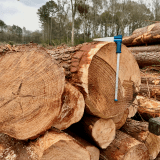
In 1991, the USDA Forest Service, Southeastern Forest Experiment Station created a set of stem-profile taper models for 58 southern species and species groups. The Research Paper, known as SE-282, can be downloaded here. The research demonstrates how profile models are used to “predict stem diameter at any height” and […]
Estimated reading time: 10 minutes

Data can come from internal or external sources. In many cases, companies need access to data that is not provided by the ongoing operation of the business. For example, forestry businesses may rely on products and applications developed using regional timber prices, historical weather patterns, location-based services, or market indices. […]
Estimated reading time: 13 minutes

In this post we will journey on an expedition to explore a forestry dataset using Data Science tools available in Python. Python is an Object-Oriented programming language commonly used in the Geospatial and Data Science fields. As an example scenario, we will work with two datasets that resemble common Stand […]
Estimated reading time: 17 minutes

