This post is about work productivity, and how Agentic AI (Agents) are changing how we think about business workflows. Agents use underlying Large Language Models (LLM) to perform tasks autonomously with simple prompting. Agent applications can integrate with other software such as Google Drive, Microsoft Office, Gmail, and web browsers to complete tasks with minimal supervision. Agentic AI is literally changing the way we work.
Some common Agents include: OpenAI’s ChatGPT Work, Microsoft’s Copilot Cowork, and Anthropic’s Claude Cowork. Agents can read, synthesize, analyze, and generate new documents, spreadsheets, dashboards, and even write computer code. They can also work with your local file system and optimize local or cloud file storage.
There are different kinds of Agents, each specializing in different types of interaction. The most common are prompt-and-response agents, task agents, and autonomous agents. Chatbots are examples of prompt-and-response, Siri and Alexa are examples of task agents, and Claude Cowork is an example of an autonomous agent (Copilot and AI Agents, 2026). Agents can perform general business tasks, or focus on specific tasks like Sales, Finance, and Supply Chain Management.
Example of a Claude Cowork Project
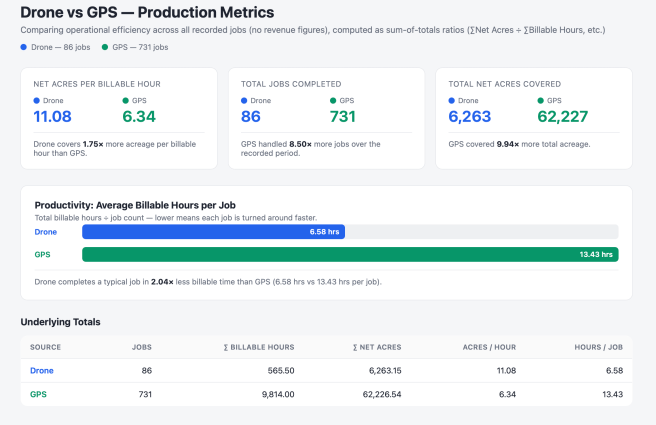
The following example demonstrate using Anthropic’s Claude Cowork – a general AI agent – to generate some business related content. The content is an HTML dashboard comparing production metrics of Drone and GPS mapping jobs.
First, a little background on prompting Agentic AI. Prompt Engineering is a growing skillset for planning and constructing AI prompts to get results that are accurate and relevant. It is the LLM equivalent of constructing a Google search to get the best results for a topic. Learning how to structure prompts is important for getting the results you want.
The prompt below was used for this example.
Access the folder /some/path/to/your/data, and locate the following spreadsheets:
- Drone_Records.xlsx
- GPS_Production.xlsx
Calculate the following metrics for each file Drone and GPS using the columns Billable Hours | Net Acres | Total Revenue:
- the average revenue per billable hour as a sum of totals ratio
- the average revenue per acre as a sum of totals ratio
- the acres per billable hour
Build an HTML Dashboard that shows and compares these metrics for Drone and GPS.
Save the file as /some/path/to/your/data/drone_vs_gps_metrics.html
This prompt tells Cowork to read two Excel spreadsheets on a local drive and calculate metrics for the drone and GPS production data using a subset of the columns in each file. Then it describes the metrics to calculate, the type of output, and the local path and filename where it should be saved. The prompt uses a made up file path, this would be a real file path on the system the agent is accessing.
The image below shows the output that was generated from this prompt. The task could be setup to run periodically as the data in the input files are changed.
Example tasks for agentic AI systems
Agentic systems can be setup to include project background information, tone rules, editorial style, and context rules about what is important and not-important. Agentic AI systems can run autonomously or with little human involvement to,
- synthesize information in one or more files into a concise summary
- generate weekly, biweekly, or monthly reports from data entered into office documents and spreadsheets
- generate and publish dashboards, media files, and content
- perform research and suggest topic outlines
- copy data from the web into a file or database for later analysis
- clean and analyze structured data
Some useful tasks for forestry companies include generating reports, publishing dashboards and content, and cleaning and analyzing data collected in the field. It is also useful for validating calculations, and providing research about topics of interest.
Summary
Agentic AI is new and exciting, but for the user it can be daunting to relinquish control of a task or workflow to an AI model. I like taking small steps, and only giving permission to the resources that the system needs to access for a specific task. Agentic AI offers increased productivity for repetitive tasks, but as users it is our responsibility to manage the access, learn better ways to prompt the system, and to review and verify the content it generates.
Agentic systems could transform how users interact with software of the future. For example, users may no longer need to work with a graphical user interface. Instead users could prompt the system to perform tasks in a more natural and conversational way. This would reduce the learning curve for software and perform work much faster and with less input errors.
References:
Copilot and AI Agents | Microsoft Copilot, https://www.microsoft.com/en-us/microsoft-copilot/copilot-101/copilot-ai-agents. Accessed July 25, 2026.
Photo by Immo Wegmann on Unsplash
Categories: artificial intelligence Data Analytics Technology Adoption


Leave a Reply